
Carbon Graphite Block
Home » Graphite Products » Carbon Graphite Block

Type: Fine-grained graphite, medium-grained graphite, coarse-grained graphite.
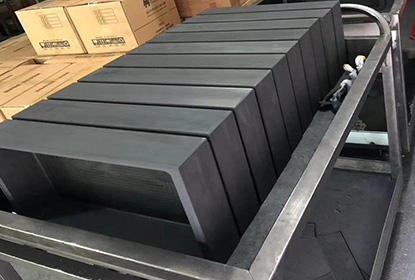
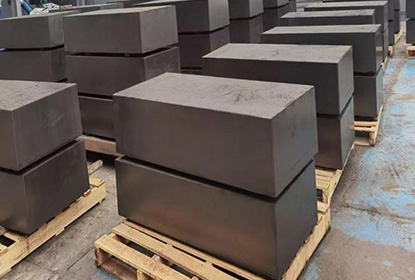
Size: Maximum dimensions up to 3600 mm (L) × 850 mm (W) × 850 mm (H); custom sizes available.
Shape: Rectangular block, cube, or customized upon request.
Carbon graphite blocks are high-purity solid materials made from natural or synthetic graphite. They offer excellent high-temperature resistance and electrical conductivity. The production process is similar to that of graphite electrodes—high-quality coke is mixed with pitch, molded, baked, impregnated, re-baked, and then graphitized at high temperatures. Precision machining completes the final graphite product. This multi-stage heat treatment ensures stability and reliability under extreme temperature and pressure conditions.
AGRM offers high-quality carbon graphite blocks in standard extruded forms, typically in rectangular or cubic shapes. Custom machining is also available to meet your specific requirements. We can produce blocks up to 3600 mm in length, 850 mm in width, and 850 mm in height, precisely tailored to your needs in size, shape, and performance.
Our Carbon Graphite Block Products
AGRM offers three main types of machined graphite blocks: fine-grain, medium-grain, and coarse-grain graphite. For detailed information on grain size and selection, feel free to contact us for expert guidance. Depending on the production process, you can also choose from vibration-molded, extruded, molded, or isostatically pressed graphite blocks.
Fine-Grain Graphite:
We provide a wide range of fine-grain graphite blocks, with standard sizes up to 600 mm x 650 mm x 2200 mm. Custom sizes are available upon request to meet your specific requirements.
Medium- and Coarse-Grain Graphite:
Medium-grain graphite blocks are available in sizes up to 500 mm x 700 mm x 2100 mm. Other dimensions can be supplied based on your needs.

Key Features of Carbon Graphite Blocks
- Exceptional High-Temperature Resistance
Graphite is among the most heat-resistant materials known, with a melting point of 3850 ± 50 °C and a boiling point around 4250 °C. Even under a 7000 °C arc for 10 seconds, graphite shows only 0.8% loss, demonstrating outstanding resistance to thermal erosion.
- Excellent Thermal Shock Resistance
With an extremely low coefficient of thermal expansion, graphite remains structurally stable during rapid temperature changes, resisting cracking and delamination. This makes it ideal for applications involving frequent heating and cooling cycles.
- Superior Thermal and Electrical Conductivity
Graphite conducts heat and electricity far more efficiently than most materials—its thermal conductivity is four times that of stainless steel, and its electrical conductivity is twice that of carbon steel, over 100 times that of typical non-metals.
- Strong Self-Lubrication and Low Friction
Graphite offers excellent lubricity, comparable to molybdenum disulfide, with a friction coefficient below 0.1. Lubrication is influenced by its flake structure—the larger the flakes, the better the performance.
- Outstanding Chemical Stability
At room temperature, graphite is highly corrosion-resistant and can withstand exposure to a wide range of acids, alkalis, and organic solvents. This makes it well-suited for use in chemical equipment and components exposed to corrosive environments.
What Is the Price of Carbon Graphite Blocks?
The price of graphite blocks varies depending on factors such as size, grade, manufacturing process, application, and market demand. Currently, market prices range from approximately $2,000 to $5,000 per ton (for reference only). Regional differences and transportation costs may also affect the final quotation.
For an accurate quote tailored to your needs, please contact us with your specifications.

Applications of Carbon Graphite Blocks
1. Graphite Electrodes – Core Component in Electric Arc Furnaces (EAF)
High conductivity and extreme heat resistance: When current passes through graphite electrodes, intense heat is generated to melt scrap metal into molten steel, making them essential in EAF steelmaking.
Custom machining available: We can process graphite blocks into electrodes of various sizes and specifications to match your equipment and optimize production efficiency.
2. Furnace Insulation – Ideal for Thermal Efficiency
High thermal stability: Graphite blocks are widely used as insulating layers in metallurgical furnaces, graphitization furnaces, and silicon carbide furnaces, effectively minimizing heat transfer.
Protects equipment and extends lifespan: Reduces heat loss and prevents overheating damage, enhancing operational safety and efficiency.
3. Heating Elements – Stable Heat Source for High-Temperature Furnaces
Extreme temperature resistance: Suitable as heating components in industrial furnaces, withstanding over 2000 °C, ideal for heat treatment and material synthesis.
Excellent temperature uniformity: Enables precise control in processes such as high-performance alloy manufacturing and ceramic sintering.
4. EDM Electrodes – Precision Machining Solution
High wear resistance and thermal stability: Performs well in EDM processes, enabling precise shaping of hard metals.
Longer service life: Reduces the frequency of electrode replacement and lowers production costs.
5. Nuclear Reactor Moderator – Key to Stability and Safety
Controls fission reactions: Used as a moderator to slow neutron speed and ensure stable nuclear fission.
Strong radiation resistance: Excellent anti-radiation and chemical stability makes it vital for long-term safety in nuclear systems.
6. Mold Making – For Complex Structures and High-Temperature Applications
Excellent machinability and compressive strength: Well-suited for mold production, especially in metal casting industries.
Used in automotive and aerospace: Ideal for high-precision, high-strength mold applications.
7. Lithium-Ion Battery Anode Material – Supporting Clean Energy
High energy density: Graphite powder serves as a stable anode material, enabling efficient lithium-ion insertion and release.
Used in EVs and electronics: Widely applied in electric vehicles, portable electronics, and green energy technologies.
8. High-Temperature Lubricant – Protection Under Extreme Conditions
Reduces friction and wear: Graphite powder forms a lubricating film under high heat and pressure, protecting moving parts.
Extends equipment life: Common in aerospace, metallurgy, and other high-temperature industries to reduce downtime.
9. Sintering Support in Powder Metallurgy – Enhancing Structural Integrity
Uniform heat distribution: Graphite blocks enable even heating during sintering, helping metal particles bond efficiently.
Ideal for complex parts: Widely used in the automotive and aerospace sectors where structural precision is critical.
Processing Methods of Carbon Graphite Blocks

The manufacturing of graphite blocks involves several forming techniques, with molding, extrusion, and isostatic pressing being the most commonly used.
- Production begins with raw material preparation. Materials such as petroleum coke and pitch are crushed and milled to achieve uniform particle size. The processed materials are then mixed and kneaded to form a homogeneous blend, improving forming density.
- Next comes the shaping stage, where the mixture is formed into green blocks using molding, extrusion, or isostatic pressing, depending on application needs. These green blocks are then baked at high temperatures to remove volatiles. An impregnation step, typically using coal tar pitch, follows to enhance density and strength. For some products, the baking–impregnation cycle is repeated to further improve performance.
- The baked blocks are then graphitized. This step takes place in a graphitization furnace at temperatures nearing 3000°C, forming a microcrystalline structure with high electrical and thermal conductivity. Finally, precision machining ensures each block meets exact size and tolerance specifications. All products undergo quality inspection to ensure they meet application standards.
AGRM is committed to high-standard manufacturing and strict process control, delivering graphite solutions with stable performance and reliable quality. Contact us for technical data or sample support.


