
Graphite Heat Exchanger
Home » Graphite Products » Graphite Heat Exchanger

A graphite heat exchanger is a specialized device designed to facilitate heat transfer between two or more fluids at different temperatures. It transfers heat from the higher-temperature fluid to the lower-temperature fluid, ensuring that the fluid temperatures meet process requirements. Graphite heat exchangers are made from impermeable graphite materials, commonly using impregnated impermeable graphite and pressed impermeable graphite.
Types of Graphite Heat Exchangers
As a leading graphite electrode supplier, AGRM has nearly 20 years of experience in customizing graphite products, ensuring product dimensions within drawing tolerances. Please contact our engineers for more personalized solutions if you have any requirements.
Graphite Block Heat Exchanger
Composed of several block-shaped graphite components with holes. There are two structural forms: circular block-type graphite heat exchangers and cubic block-type graphite heat exchangers.
Made up of several graphite blocks with material channels, upper and lower graphite end caps, and metal cover plates, along with a cylindrical steel shell (for circular block-type) or two end covers (for cubic block-type). The components are sealed with gaskets and fastened with long bolts.
In a circular block-type graphite heat exchanger, a series of equally spaced, parallel holes of the same diameter and length are drilled inside the graphite cylinder, with the holes connecting the inner and outer surfaces of the graphite cylinder. Fluids flow through these holes, transferring heat to the graphite blocks through contact and then conducting it to the other side.
In a cubic block-type graphite heat exchanger, a series of rectangular-section holes are created inside the graphite cube, with the holes connecting the inner and outer surfaces of the graphite cube. Fluids enter from one side of the hole, transferring heat through contact with adjacent graphite blocks.
Commonly used in processes such as heating, cooling, and evaporation in the chemical, petroleum, and metallurgical industries.
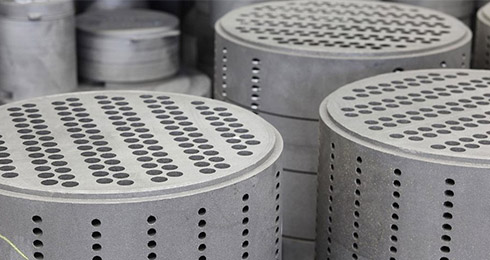
- Excellent corrosion resistance and heat transfer performance, suitable for heat transfer processes involving corrosive media. It can withstand acids, bases, and other corrosive substances, making it widely used in both organic and inorganic chemistry fields.
- We provide different design solutions based on the characteristics of the materials.
Graphite Shell And Tube Heat Exchanger
Also known as a shell-and-tube heat exchanger, this type uses the surface area of the tubes enclosed in a shell as the heat transfer surface. It can be divided into fixed and floating head types.
During operation, fluids pass through the graphite tubes and exchange heat with the surface of the tubes to achieve heat transfer.
Primarily used for heating, cooling, condensing, evaporating, and absorbing materials, it can handle most organic or inorganic media, particularly suited for phosphoric acid concentration.

- Simple structure and reliable operation can be made from various structural materials (mainly metals) and are suitable for use under high temperatures and pressures. It is the most widely used type.
- Large flow capacity with low fluid resistance, capable of manufacturing larger graphite heat exchangers.
- Leakage points are easy to locate.
- Uses single-tube sealing, which eliminates stress caused by expansion, and each tube can be independently removed or replaced, facilitating maintenance.
Comparison of Graphite Heat Exchangers
Graphite Block Heat Exchangers
1. For cooling purposes, graphite block heat exchangers are usually rectangular, with square or rectangular graphite components; for heating purposes, they are typically circular, with circular graphite components or circular components with central holes.
2. High-pressure resistance, high material utilization, capable of withstanding significant pressure, compact structure, small size, and high heat transfer coefficient. They can be used as heaters, coolers, condensers, etc.
3. Due to the small pore size, they are prone to clogging and are not suitable for heat transfer involving crystallizing substances.
Graphite Shell And Tube Heat Exchanger
1. Divided into vertical and horizontal types based on installation position; single-flow and double-flow types based on flow direction; floating head types are further divided into Type I without a gas-liquid separator and Type II with a gas-liquid separator.
2. Simple structure, easy manufacturing, high material utilization, low cost, large heat transfer area, low fluid resistance, and versatile applications. Can be used as coolers, condensers, heaters, evaporators, etc.
3. Lower pressure and temperature resistance compared to circular block-type graphite heat exchangers.
Advantages of AGRM Graphite Heat Exchangers
- Exceptional Corrosion Resistance
Various types and grades of products meet high corrosion conditions.
- Design Flexibility
Corrosive media can flow inside or outside the tubes, or both sides can be designed to handle corrosive media. The shell and end caps can be made from various materials and can have different special structural forms.
- Compact and Durable
Excellent thermal conductivity of materials, combined with professional design and manufacturing techniques, ensures compact and efficient equipment.
- Safety and Stability
Various reliable and mature sealing systems ensure long-term safe and stable operation under various conditions. Optional carbon fiber reinforcement technology can significantly reduce damage caused by stress beyond limits, even in extreme temperature or pressure conditions.
- Easy Maintenance
Quick cleaning and maintenance with minimal downtime costs.
- Excellent Service
Comprehensive lifetime service with fast, effective, and high-quality support.
- Cost-Effectiveness
Shell-and-tube graphite heat exchangers are relatively inexpensive.
Why Use Impermeable Graphite Materials in Heat Exchangers?
Graphite heat exchangers mainly use impermeable graphite materials. Impermeable graphite is a new structural material made from synthetic graphite and resin through methods such as impregnation, pressing, and casting. Unlike other non-metallic corrosion-resistant materials, it not only has high chemical stability but also high thermal conductivity, does not contaminate the medium, and is resistant to scaling, significantly expanding its range of applications. Additionally, the use of impermeable graphite in heat exchangers is due to its chemical stability. Impermeable graphite is corrosion-resistant to most chemical media except strong oxidizing acids and bases, particularly media containing chloride ions. In terms of thermal stability, phenolic-impregnated graphite can generally withstand temperatures around 1700°C with a low thermal expansion coefficient of approximately 0.4 to 0.45×10⁻⁶/K. In terms of thermal conductivity, impregnated graphite has a thermal conductivity of 100-110 W/m·K, similar to copper and aluminum, and more than 2.5 times that of ordinary carbon steel, which is why it is often used to make graphite heat exchangers.
- High Chemical Stability: Insoluble in organic and inorganic solvents, and acids and bases have no effect under normal conditions.
- High Electrical and Thermal Conductivity: Low thermal expansion coefficient.
- Good Resistance to Sudden Temperature Changes: Does not contaminate the medium, ensuring product purity.
- Good Processability: Lightweight.
Why AGRM?
Exceptional Materials
High-quality materials, professional design knowledge, manufacturing techniques, strict quality control, and comprehensive service set our graphite chemical equipment apart from all other graphite equipment on the market.
Impact of Impregnated Graphite Quality
The quality of impregnated graphite significantly affects block-type graphite heat exchangers. We offer three different grades of impregnated graphite based on customer requirements and applications. To expand the use range of impregnated graphite, we have also developed a series of synthetic resin-impregnated graphites.
Ensuring Reliability and Safety
Our ThermIG block-type graphite heat exchangers use whole graphite blocks, with a maximum diameter of 1800 mm.


