
Custom Graphite Molds
Home » Graphite Products » Graphite Molds

Custom Shapes and Sizes: Production based on sketches or drawings provided by customers.
Types: Graphite continuous casting molds, exothermic welding molds, hot-pressing sintering molds.
Various tools and products used in our daily production and life, from large machine bases and casings to small buttons, all have a close relationship with molds. The shape of the mold determines the appearance of these products, and the processing quality and precision of the mold determine their quality. In recent years, the mold industry has developed rapidly, with graphite materials, new technologies, and an increasing number of mold factories continuously impacting the mold market. Graphite, with its excellent physical and chemical properties, has gradually become the primary choice material for graphite mold production.
As a leading graphite electrode supplier, AGRM has nearly 20 years of experience in customizing graphite products, ensuring product dimensions within drawing tolerances. Please contact our engineers for more personalized solutions if you have any requirements.
Graphite Molds and Dies for Continuous Casting

- What is Continuous Casting?
Continuous casting is an efficient metal forming process suitable for producing various shapes and sizes of metal ingots, widely applied in the production of steel, aluminum, and their alloys.
During continuous casting, metal is injected from the furnace into continuous casting machines where molds play a crucial role in cooling and shaping. The mold’s interior walls are cooled rapidly via a water cooling system to gradually solidify and shape the metal, which is then cut by cutting machinery into ingots of desired lengths. These ingots can undergo further heat treatment, rolling, or other processing to meet diverse application requirements.
- Why Graphite Molds are Preferred for Continuous Casting?
- Excellent thermal conductivity (critical for determining the solidification rate of metals or alloys).
- Good self-lubricating properties.
- Molten metals do not wet our non-porous and non-reactive graphite.
- Graphite can withstand temperatures up to 3,300°C, far exceeding the melting temperatures of metals.
- High thermal conductivity.
- Easily machinable into polished surfaces.
- Graphite is widely used in continuous casting molds, enabling the production of various alloys such as gray cast iron, white copper alloys, nickel silver, aluminum bronze, or precious metal alloys.
- Importance of Molds: They influence the final product’s quality and directly impact production efficiency and costs.
- Key Mold Characteristics: Excellent wear resistance and thermal conductivity ensure stable operation and rapid metal cooling in high-temperature and high-pressure environments.
- Considerations in Mold Design and Selection: Nature of metal flow, as well as accurate dimensions and surface quality requirements of the finished ingots.
- AGRM provides a wide range of reliable graphite molds with excellent thermal performance, compatible with non-ferrous metals such as copper, brass, bronze, gold, and silver. We collaborate with clients to enhance mold performance and have extensive experience in casting various graphite molds to meet all your casting applications.
- Precise ingot dimensions, smooth surfaces, uniform crystalline structure.
- Direct processing into subsequent operations to increase casting speed.
- Substantial increase in yield, reduction in scrap loss, and significant enhancement in product quality.
Graphite Molds and Moulds for Exothermic Welding
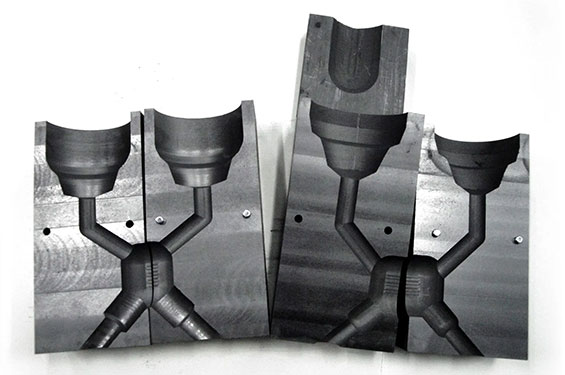
- What is Exothermic Welding?
Exothermic welding is a common metal welding process that involves heating metal materials above their melting point to form uniform weld joints under controlled pressure. It is widely used in the metal industry for effectively joining different types and thicknesses of metal materials, as well as combinations of metal and non-metal materials.
General Process of Exothermic Welding
Mold Installation
Molds are used to position and secure welding components. A complete exothermic welding mold consists of mold concrete, a top cover, and hinges.
- Mold concrete: Supports and fixes the main part of the mold structure, possessing good heat resistance and durability to withstand high temperatures and pressures during welding.
- Top cover: Located above the mold, it secures and compresses the materials to be welded, ensuring smoothness and tightness of the weld joint.
- Hinges: Connect the top cover and mold concrete, allowing the top cover to move freely relative to the mold concrete for easy operation and cleaning of the welding area.
Preheating
Before actual welding, the welding area is typically preheated. Preheating helps reduce thermal stresses and the formation of cold cracks during welding, improving the quality and reliability of the weld joint.
Welding Operation
Welding operations involve generating high temperatures on the weld joint using an arc or other heat sources, melting the joint, and bonding it with filler material. During welding, the mold maintains the accurate position and spacing of the weld joint, ensuring stability and consistency in the welding process.
Cooling and Post-treatment
After welding is completed, the welded joint requires appropriate cooling time. During cooling, care must be taken to avoid cracks caused by too rapid cooling. After cooling, necessary post-treatment such as grinding, cleaning, and inspection of welding quality can be carried out.
- AGRM can customize molds of different shapes and specifications according to specific welding requirements, meeting personalized customer demands.
- Lower density for lighter weight.
- Long service life.
- Simple operation without external power sources and heat sources.
- Low welding cost, stable and reliable quality.
- Easy to process into various complex mold shapes and sizes.
Graphite Molds and Moulds for Hot Pressed Sintering
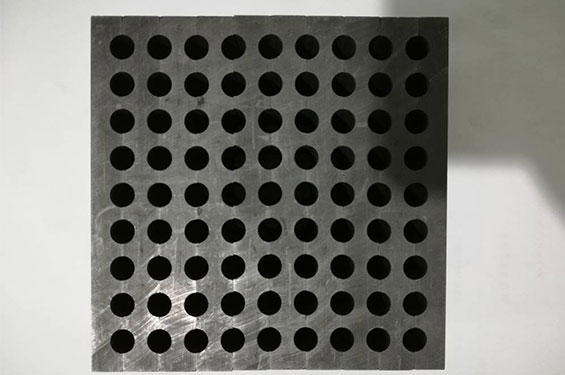
- What is Powder Metallurgy?
Powder metallurgy is a process technology for making metal materials, composite materials, and various types of products using metal powder (or a mixture of metal powder with non-metallic powder) as raw materials through forming and sintering processes. Powder metallurgy processes can produce a variety of products, such as diamond tools, hard alloy drills, hard materials, magnetic materials, FGM, etc.
- Graphite molds are consumables in powder metallurgy processes, where powder materials are loaded into graphite molds for sintering or hot pressing. The performance of graphite molds directly affects the quality of sintered products and production costs.
- Forming molds: Used to press powder into shape, mold design influences the final product’s dimensional accuracy and complexity of shape.
- Sintering molds: During sintering, these molds support and fix the green compact to ensure no deformation or damage under high temperatures.
- AGRM, with deep understanding of various grades of graphite materials and powder metallurgy process data, selects optimal graphite materials for processing graphite molds for different processes and equipment. Our molds undergo precision machining to meet all customer production requirements.
- Good thermal conductivity: Excellent thermal conductivity ensures uniform heat transfer during sintering, aiding temperature control and uniformity.
- High-temperature resistance: Stable under high temperatures, maintaining shape without deformation or damage, suitable for use under high-temperature sintering conditions.
- Long service life: Our molds demonstrate long-term durability, enduring multiple pressing and sintering cycles without failure, thus reducing production costs and cycles.
Why AGRM?
- High-quality graphite materials.
- Precision machining.
- Secure packaging.
- Strict quality inspection.
- Professional technical consultation.
- One-stop after-sales service.
- Custom Solutions
- Advanced graphite processing equipment and superb production technology.
- Capable of processing various high-difficulty products as per customer requirements.
- Precision machining with a tolerance of +/-0.01mm.
- Raw Materials
- Sourced from the most recognized and reliable suppliers in the industry.
- High hardness, good strength, long service life.
- Professional Factory
- Rich experience in graphite mold production.
- Competitive pricing.
- Compact product design, low maintenance costs, and long service life.
- Samples
We provide free samples and ship them promptly. Usually, shipping costs are borne by the customer, which will be refunded upon receipt of a formal order.
- Quality Inspection
We have a dedicated testing center and team. Products are shipped only after passing quality inspections.


