

EDM stands for Electrical Discharge Machining, a thermal removal process capable of machining metals that traditional methods cannot handle. It manufactures complex-shaped parts from various conductive materials, ensuring strict tolerances and smooth surfaces. EDM is the preferred machining method when higher precision than conventional methods is needed.
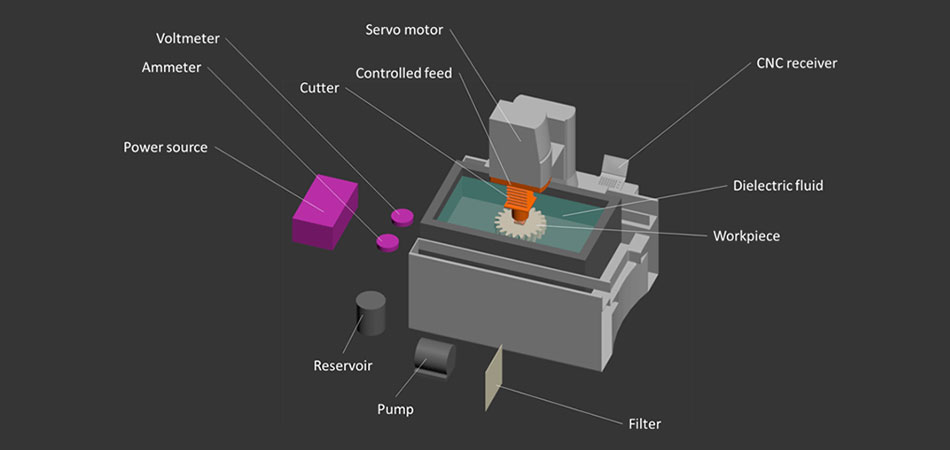
In EDM, the shape of the pre-machined conductive electrode is the opposite of the shape of the part to be manufactured. An EDM machine feeds electrodes into a workpiece immersed in a dielectric fluid. From there, the workpiece is corroded by electrical charges. The process removes the material and creates a cavity in the workpiece that is the same shape but slightly larger than the electrode.
Properties of Edm graphite materials
EDM electrodes consist of highly conductive materials, such as graphite or copper, and are resistant to arc corrosion. The materials used to make EDM electrodes need to have a double and slightly contradictory property: quickly allowing charge flow while resisting the resulting corrosion properties. In other words, although the workpiece must be corroded by discharge, the electrode itself should not be corroded.
The EDM graphite electrode is currently perhaps the most suitable EDM electrode available, known for its ability to maintain a clean effect even at low speeds. The brush material grade originally produced was made of carbon graphite. It is commonly used in various aging generators and motors. Its amorphous structure is also characteristic of graphite.

- Faster processing speed. Under normal circumstances, the machining speed and discharge speed of graphite are faster than that of copper.
- Materials are less prone to deformation. It has obvious advantages in the processing of thin rib materials. The softening point of copper is about 1000 degrees, which is easy to be deformed by heat, the sublimation temperature of graphite is 3650 degrees, and the coefficient of thermal expansion is 1/30 of copper.
- Lighter weight. The density of graphite is only 1/5 of copper, which can effectively reduce the burden of the machine tool (EDM) when the large electrode is discharged and is more suitable for the application of large molds.
- Less discharge consumption. Because the spark oil also contains C atoms, during the discharge processing, the high temperature causes the C atoms in the spark oil to be decomposed, and the protective film is formed on the surface of the graphite electrode, which compensates for the loss of the graphite electrode.
- No burrs: The copper electrode needs to be manually removed after processing, while the graphite is processed without burrs, which not only saves a lot of cost and manpower but also makes it easier to achieve automated production.
- Low cost: the price of the same volume of graphite is only 25% of the copper electrode. When used as an electrode for EDM, the graphite phase consumption of EDM is only 1/3-1/5 of the copper electrode, and the spark oil decomposing carbide coating compensates for the electrode loss.
Why choose graphite as EDM electrode material?
In EDM, selecting the appropriate electrode material is an important factor to ensure the machining quality and improve productivity. In the process of use, the electrode cavity is different, the size or shape is very different, and it is difficult to unify the tool electrode. Therefore, the selection of electrode materials should follow the following principles.
- Based on analyzing the characteristics and technical requirements of the workpiece (surface roughness, size, tolerance accuracy), the electrode material is selected according to the workpiece material and technical requirements.
- First, choose a material with good thermal conductivity and a high melting point as the electrode material.
- take into account the electric easy forming, good processing performance, and other factors, to obtain a good EDM effect.
Material property
Graphite has a variety of material properties that can be matched to a variety of EDM applications. For general applications, larger particles, lower strength, and affordable electrodes can be used. However, if it is a fine EDM electrode with critical characteristics, extreme tolerances, and strict EDM requirements, EDM graphite is the best choice.
On the other hand, there are few types of copper available on the market, which minimizes the ability to match material properties to EDM applications, thus limiting optimal performance.
Wear resistance (WR)
There are four types of wear: volume wear, angular wear, end wear, and side wear. Of these four types of wear, we consider angular wear to be the most important because the final cut profile depends on the ability of the electrode to resist erosion at the corners and edges. Therefore, if the electrode can successfully resist erosion at the most vulnerable points, the overall wear will be minimized and the electrode life will be maximized. Electrode erosion cannot be prevented, but it can be minimized by selecting the appropriate electrode material/workpiece metal combination and machining in the optimal setting.
The ability of the electrode to produce and retain detail is directly related to its wear resistance and machinability. To minimize angular wear, electrode materials with both high strength and high-temperature resistance need to be selected.
Surface finish (SF)
A fine surface finish is achieved by combining the appropriate electrode material, good flushing conditions, and appropriate power Settings. High frequencies, low power, and orbital motion produce the best finish because these conditions create smaller, less-defined pits in the workpiece metal. The final surface finish will be a mirror image of the electrode surface, so Angstrofine and ultra-fine particle high-strength graphite are the best choices for finishing electrodes.
machinability
Any mechanic who has ever worked with graphite knows that graphite is very easy to cut. Simply being easy to process does not necessarily mean that a material is the best choice for electrodes. It must also be strong enough to resist damage caused by handling and the EDM process itself. Strength and small particle size are important so that minimum radius and tight tolerances can be achieved. Material hardness is also a factor in the machinability of graphite, as harder electrode materials are more likely to break during processing.
Material cost
Electrode material costs are usually only a small part of the total cost of an EDM. However, what is often overlooked is that it makes no sense to exclude electrode material costs from the total cost.
Manufacturing time, cutting time, labor, electrode wear – all these factors depend more on the electrode material than anything else. Therefore, it is critical to understand the properties and performance characteristics of the available electrode materials, as they affect the workpiece metal you are processing. Only with this data will it be possible to conduct a cost/performance analysis to determine the true cost of EDM work.