
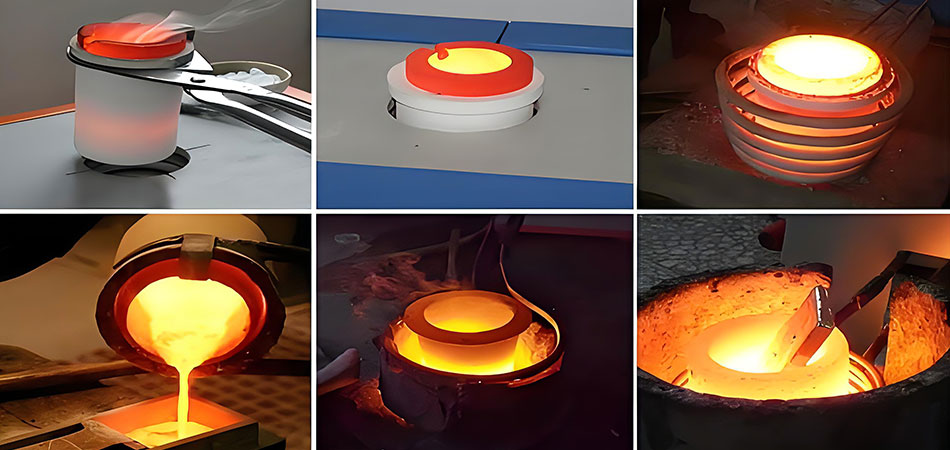
In the fields of metal smelting, casting, and high-temperature material processing, the melting stage is critical for production efficiency, product quality, and operating costs. Many melting issues are not caused by the furnace itself, but rather by a mismatch between the crucible material, metal properties, and operating conditions.
As a company specializing in graphite crucible R&D and manufacturing, AGRM focuses on material compatibility, process stability, and service life as the core principles of crucible design, offering reliable solutions for long-term operation across various metal melting applications.
Common Challenges in Metal Melting Processes
In practice, clients often encounter:
- Slow melting, uneven heating, and high energy consumption
- Cracking or premature failure of crucibles under high temperatures
- Metal contamination is affecting alloy composition and product quality
- Frequent crucible replacement, increasing maintenance costs, and downtime
- Poor adaptability across different furnace types, limiting process flexibility
AGRM’s engineering experience shows that these issues can often be effectively mitigated by selecting and using graphite crucibles properly.
Challenge 1: Uneven Heating and Limited Melting Efficiency
AGRM Solution: High Thermal Conductivity Graphite Crucible Design
Graphite naturally offers excellent thermal conductivity. During crucible design and material formulation, AGRM controls graphite particle size and compaction process to ensure rapid and uniform heat transfer during heating. This is especially beneficial for: Aluminum (660°C), Copper (1085°C), Gold (1064°C), Silver (961°C).
Uniform heat distribution reduces single-batch melting time, minimizes localized overheating and metal loss, lowers energy consumption, and improves overall productivity.
Challenge 2: High Temperature and Thermal Shock Leading to Cracking
AGRM Solution: Stable Thermal Shock Resistance
In industrial melting, crucibles often undergo frequent cycles of heating, holding, and cooling. If the material has a high coefficient of thermal expansion or insufficient structural toughness, it is prone to cracking under temperature fluctuations.
AGRM graphite crucibles are made from a low-thermal-expansion graphite material system. When operated under proper heating and standardized conditions, they can effectively withstand the structural stresses caused by repeated thermal cycles, reducing the risk of sudden failure due to thermal shock. This also extends the service life of each crucible and enhances the continuity and controllability of production schedules. Such reliability is especially critical for engineering projects that require stable delivery timelines.
Challenge 3: Metal Contamination During Melting
AGRM Solution: Chemical Inertness and Purity Control
Molten metals are highly chemically reactive, and if the crucible material reacts or elements migrate, it can directly affect the purity of the metal. Graphite exhibits excellent chemical stability at high temperatures. During production, AGRM emphasizes raw material purity and process consistency, ensuring that graphite crucibles perform reliably in the following applications:
- Precious metal melting: Gold, silver, platinum
- Alloy melting with strict composition control
- High-temperature melts for laboratory and materials research
Challenge 4: Short Service Life and High Total Cost
AGRM Solution: Crucible Design Optimized for Long-Term Operation
According to AGRM’s actual customer data, the purchase price of a crucible is not the main factor in total cost. The key determinants are service life, stability, and maintenance frequency. AGRM graphite crucibles are specifically optimized in the following aspects to achieve lower replacement frequency, reduced downtime, and clearer cost predictab
- Smooth inner walls to reduce metal adhesion and residue
- Enhance wear and corrosion resistance
- Provide predictable performance decay under standard conditions
Challenge 5: Adaptability to Different Furnace Types and Conditions
AGRM Solution: Multi-Furnace Compatibility and Customization
AGRM graphite crucibles are suitable for a variety of common furnace types, including induction furnaces, resistance furnaces, and gas furnaces. In addition, AGRM can customize the size, wall thickness, and structural design of the crucibles according to the specific operational requirements of customers, in order to accommodate different metal melting capacities, furnace chamber spaces, and operating methods, providing greater process flexibility for engineering projects.
How to Choose the Right Graphite Crucible for Your Project
AGRM recommends focusing on the following key parameters when selecting a graphite crucible:
- The type of metal to be melted and its maximum operating temperature
- Furnace type and heating method
- Crucible density, ash content, and oxidation resistance
- Whether multiple metals or alloys will be melted
Common Metals for AGRM Graphite Crucibles
AGRM assists clients at the early stage of a project by evaluating the properties of the metals and the operating conditions. Under proper selection and process control, AGRM graphite crucibles are widely used for melting the following metals:
- Low-melting-point metals: Aluminum, Lead, Zinc
- Medium-melting-point metals: Copper, Brass, Silver, Gold
- Higher-melting-point metals: Nickel, Steel, Iron (requires controlled atmosphere and temperature)
- High-melting-point precious metals: Platinum (requires precise thermal management)
Usage Instructions for Metal-Melting Graphite Crucibles
1. Preparation
- Select the appropriate graphite crucible: Choose a crucible size that matches the type and weight of the metal to be melted.
- Clean and dry the crucible: Wipe the inside and outside of the crucible with a mild cleaner and soft cloth to remove any impurities or debris. Then, place the crucible in an oven to dry, preventing water from causing cracking during high-temperature heating.
2. Crucible Installation
- Secure the crucible: Place the graphite crucible inside the furnace, ensuring the bottom is in close contact with the furnace floor to prevent heat loss and metal leakage.
- Install a protective ceramic sleeve: Place a ceramic sleeve around the crucible to protect it from mechanical damage during operation.
3. Preheating
- Gradual heating: Slowly raise the temperature inside the furnace to avoid thermal shock to the crucible.
- Reach the target metal melting temperature: Heat the crucible to the required temperature according to the metal’s melting point and process requirements. Gas or resistance furnaces can be used for heating.
4. Metal Melting
- Add metal samples: Place the metal pieces evenly into the crucible.
- Melt the metal: Continue heating until the metal fully melts. Maintain the appropriate temperature and stir the molten metal for thorough mixing.
- Remove impurities: Add fluxes or degassing agents as needed to eliminate impurities or gases in the metal.
- Pouring or casting: Once molten, pour the metal into molds or perform casting as required.
5. Cooling and Cleaning
- Stop heating: After melting and casting, gradually reduce the furnace temperature to avoid thermal shock.
- Natural cooling: Allow the crucible to cool naturally to room temperature.
- Clean and maintain: Remove the crucible and clean the inside and outside with a soft cloth and mild cleaner to remove any metal residues.
- Storage and care: Store the crucible in a dry, ventilated area, away from direct sunlight and mechanical impacts to extend its service life.
Graphite crucibles are not simple consumables—they directly impact melting quality, production rhythm, and operating costs. AGRM continually optimizes materials and processes to maintain a reliable balance of thermal conductivity, thermal shock resistance, and chemical stability, helping clients handle complex melting conditions efficiently.
For metal-specific, furnace-specific, or production-condition-based selection advice, contact AGRM for expert recommendations and application support.