
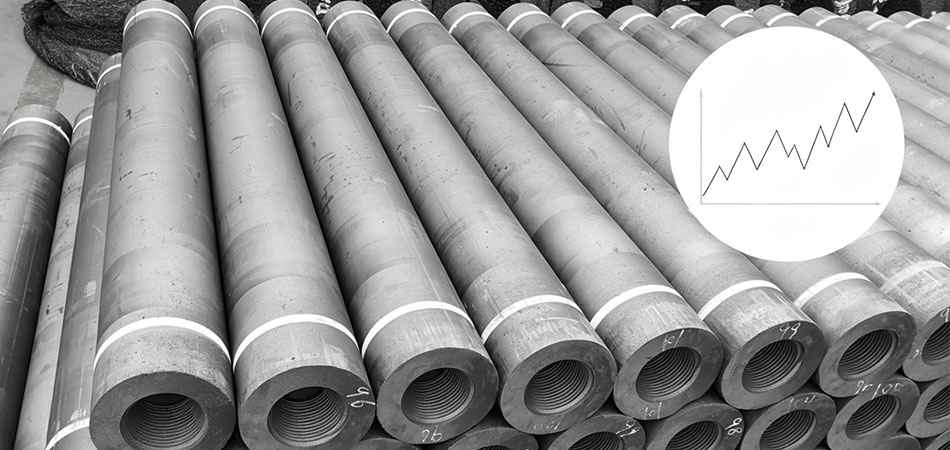
How much should a ton of graphite electrodes cost be considered reasonable? During the actual purchasing process, you may find that the quotations from different suppliers vary significantly and the prices fluctuate frequently. In fact, the price of EAF graphite electrodes is not only affected by market supply and demand, but also closely related to various factors such as raw material costs, power level (RP/HP/UHP), and production processes.
This article will provide you with a detailed introduction to the latest prices of graphite electrodes for electric arc furnaces in 2026, the key factors influencing the quotations, and the market trends. It will help you avoid making mistakes and reasonably control your procurement costs.
Latest Price of Graphite Electrodes
The table below presents the reference price ranges for the FOB (Free On Board) prices of major Chinese ports in the first quarter of 2026. The actual prices may vary depending on the order quantity, specific specifications, and payment method.
AGRM can offer FOB/CIF quotations and provide tiered discounts for large orders. Contact us for the latest quotations!
| Grade | Diameter (mm) | Length (mm) | Typical Applications | Price Range (USD/ton) |
| UHP (Ultra High Power) | 300 – 700 | 1600 – 2700 | Large electric arc furnaces / special steel smelting | $2,100 – $2,700 |
| HP (High Power) | 200 – 700 | 1600 – 2400 | High-power steelmaking furnaces / refining furnaces | $1,900 – $2,300 |
| RP (Regular Power) | 150 – 700 | 1200 – 2100 | Industrial silicon / yellow phosphorus smelting / scrap melting | $1,600 – $1,900 |
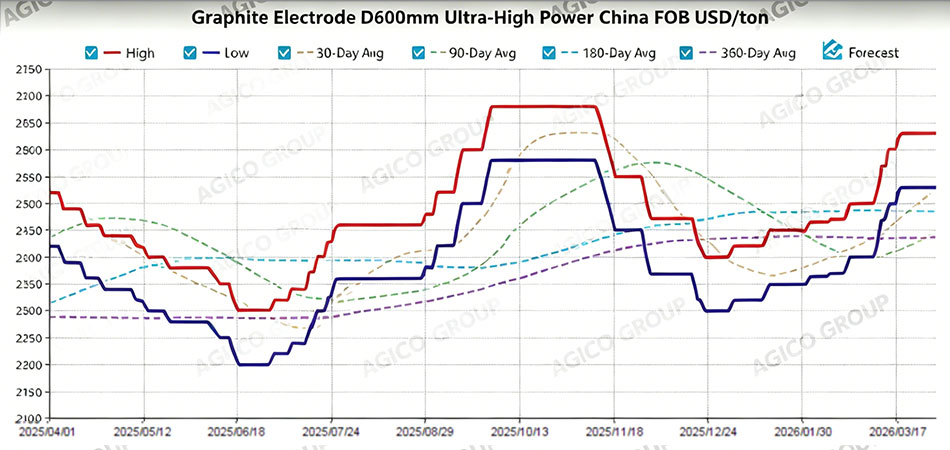
The following is the curved graph of the offshore price of UHP graphite electrodes of 600 mm in China over the past year (from April 1, 2025, to April 1, 2026):
The Key Factors Influencing the Price of EAF Graphite Electrodes
1. Raw material cost (needle coke)
Needle coke accounts for over 60% of the production cost of graphite electrodes, especially for ultra-high power (UHP) electrodes, as the proportion of high-quality needle coke in their raw materials is relatively high. Changes in the demand for needle coke have intensified the fluctuations in the prices of UHP electrodes. In contrast, the prices of high-power (HP) and regular power (RP) electrodes are more stable.
2. Power grade
High-grade graphite electrodes perform better in terms of thermal expansion coefficient, thermal shock resistance, working temperature/load, cost and service life, but they also have a higher cost. The selection of grades should be based on the type of furnace. Here are the main differences between the different types of graphite electrodes:
| Item | Regular Power (RP) | High Power (HP) | Ultra High Power (UHP) |
| Raw Materials | Regular petroleum coke | Premium petroleum coke + partial needle coke | Mainly high-quality needle coke |
| Bulk Density (g/cm³) | 1.50–1.60 | 1.60–1.70 | 1.68–1.75 |
| Electrical Resistivity (μΩ·m) | 7.5–9.0 | 5.5–7.5 | 4.5–5.8 |
| Flexural Strength (MPa) | 8–12 | 10–14 | 12–18 |
| Elastic Modulus (GPa) | 7–9 | 9–12 | 10–14 |
| Allowable Current Density (A/cm²) | 10–15 | 15–25 | 25–35 |
3. Geometric dimensions
For large-diameter electrodes (such as 700mm), a more uniform graphitization process is required during the production process, resulting in a lower yield and increased production costs. Therefore, diameter is a key factor affecting the price. Roughly estimated, the price of 700mm ultra-pure electrodes is usually 15% to 25% higher than that of 500mm ultra-pure electrodes.
Length also affects the price of graphite electrodes. The standard length of the electrode is generally 2100-2700mm. An increase in length can reduce the consumption of joint quantities, but it will increase the difficulty in transportation and thus the cost.
4. Market Supply and Demand Relationship
The price of graphite electrodes exhibits a distinct cyclical fluctuation pattern. When the steel industry is in a prosperous state, the operating rate of electric arc furnaces increases, leading to an increase in electrode demand and a subsequent rise in price.
5. Transportation and Export
For overseas customers, when making purchases, they also need to consider shipping costs (which are significantly affected by shipping routes and fuel prices), tariffs and trade policies, as well as packaging and logistics costs (large-sized electrodes require special pallets and reinforced packaging).
6. Customization Requirements
Requirements that exceed the standard specifications will increase the production difficulty, thereby affecting the quotation. For instance, special sizes or connector (Nipple) specifications, etc.
7. Production Process and Energy Consumption
The production process of graphite electrodes includes shaping, firing, impregnation, and graphitization. Among these steps, the graphitization process (at a high temperature of approximately 3000°C) is the most energy-consuming part. Therefore, the adjustment of industrial electricity prices in the manufacturing base will directly affect the factory cost. Due to the advantages in energy and labor costs, the price of graphite electrodes in China is usually lower than that of locally produced products in Europe and the United States.
Cost of Electrodes Per Ton of Steel: Why Can’t We Just Look at the Unit Price?
In addition to comparing “per ton price,” there is another more important indicator, which is the cost of electrodes per ton of steel—that is, the cost of electrodes consumed in the production of each ton of molten steel. The cost of an electrode per ton of steel can be calculated using the following formula: C = (Q × P) / S.
Among them, C represents the cost of the tonnage steel electrode, Q represents the electrode loss amount (in kg), P represents the unit price of the electrode (in yuan/kg or dollars/kg), and S represents the steel output (in tons).
From the formula, we can see that unit price and consumption together determine the final cost. There are clear differences in consumption per ton of steel for electrodes of different grades. Lower-grade graphite electrodes have a lower unit price, but higher consumption per ton of steel. The quality of electrodes from different manufacturers varies, which also affects the amount of wear and tear. So, besides comparing unit price, the more important thing is the long-term total cost.
Global Outlook for Graphite Electrode Industry (2026 – 2030)
In the medium and long term, the growth of electric furnace steel production, the implementation of carbon neutrality policies, and the expansion of demand in the field of new energy batteries will jointly drive the continuous expansion of the global graphite electrode market.
Regional Mode
The Asia-Pacific region holds a dominant position in the market. China and India are the core growth engines, enjoying significant manufacturing cost advantages. North America and Europe together account for approximately 30% to 40% of the global market share.
Core Driving Factors
Electric furnace steelmaking output continues to increase: The global steel industry is accelerating its transition from the high-temperature blast furnace-converter long process to the electric arc furnace short process.
The promotion of carbon neutrality policies: Strict restrictions on carbon emissions imposed by various countries have prompted steel enterprises to increase the share of electric-furnace steelmaking. The “Green Steel” initiative in Europe and the “Dual Carbon” target in China have brought long-term benefits to the graphite electrode market. The carbon emission per ton of steel in the electric furnace short process is only about one-third of that in the long process.
The new energy sector has opened up new growth points: The demand for graphite (needle coke) as the negative electrode material for lithium-ion batteries has grown rapidly, leading to a raw material competition with the graphite electrode industry. At the same time, the application of graphite electrodes in battery manufacturing equipment is also becoming increasingly widespread, becoming a new growth point for demand.
Demand for high-quality steel is on the rise: The automotive, aerospace, and defense industries have driven the consumption of ultra-high power (UHP) graphite electrodes.
Main Trend Outlook (2026 – 2030)
The wide application of high-power and large-capacity electric furnaces has driven the continuous growth of the market share of ultra-high-power (UHP) electrodes. It is expected that by 2026, the market share of UHP electrodes will reach approximately 80%. At the same time, the continuous optimization of manufacturing processes and technological advancements helps stabilize prices and improve the cost-performance ratio of the products.
The low-temperature regeneration technology can restore the layered structure of used graphite electrodes to 85%. It is expected that by 2026, the scale of reutilization of regenerated graphite electrodes will exceed 3.5 billion yuan. Regenerated electrodes provide new purchasing options for customers with limited budgets.
The tariff policies between China and the United States, as well as between Europe and the United States, have increased the cost of cross-border trade. AGRM can assist customers in choosing the best solution and reducing the burden of tariffs. We offer a full range of electrodes, including RP, HP, and UHP, to meet different budget and furnace type requirements. Please contact us to obtain the latest market quotations and selection suggestions tailored for your furnace type.
Reference
- Graphite Electrode Market Size, Share & Industry Analysis, By Type (Regular Power (RP) Graphite Electrode, High Power (HP) Graphite Electrode, Ultra High Power (UHP) Graphite Electrode, and Others), By Application (EAF steelmaking, LF (Ladle Furnace), and Others), and Regional Forecast, 2026-2034
- Graphite Electrodes- Global Market Share and Ranking, Overall Sales and Demand Forecast 2026-2032
- Graphite Electrode Global Market Report 2026